
Ai
AI Tools for Lead Generation: 12 Tools That Find You Customers (2026)
Twelve AI tools that help small businesses find leads, check contact details, and send outreach — with honest free-plan limits and prices.

 By Taylor Orlando
·November 29, 2026

Learning a new language used to mean classes, textbooks, and waiting for a tutor to be free. Now you can open an AI chat app and start a conversation in Spanish, French, Japanese, or dozens of other languages any time you like. This guide shows you how to use AI to learn a language the right way: as a daily practice partner that helps you speak, write, and understand more, without the bad habits that slow most learners down.
Last updated: November 2026
AI is very good at a few specific jobs. It can chat with you at any hour, correct your writing in seconds, explain a grammar rule in plain words, and rewrite a hard text so you can read it at your level. It never gets tired of the same mistake, and it never judges you for it.
It is not good at everything. AI cannot replace real people, real listening, or a clear plan. It will not notice what you keep avoiding, and it sometimes states a grammar rule that is simply wrong, especially in less common languages. Think of AI as a practice partner, not a teacher. The learning still comes from you: regular speaking, reading, and listening, with AI filling the gaps between lessons.
That matters because the biggest problem for most self-taught learners is not a lack of material. It is a lack of practice producing the language. AI fixes that part. It does not fix the rest on its own.
Before you type a word, tell the AI two things: which language you are learning, and your level. Use the CEFR scale, the six-level scale from A1 (beginner) to C2 (advanced) that most courses and tests use. You can read a plain summary of the levels on the Common European Framework of Reference for Languages page.
A good opening message looks like this:
“I am learning Spanish at A2 level. My goal is to hold a simple conversation when I travel in six months. I have 20 minutes a day. Act as my language tutor. Use short sentences, and correct my mistakes after each reply.”
That one message does three useful things. It sets the level, so the AI does not use words you cannot follow. It sets the goal, so practice stays on real situations. And it sets the correction rule, so you actually learn from mistakes instead of just chatting past them.
If you do not know your level, say so. Ask the AI to give you a short test: ten sentences to translate, or a short paragraph to read and answer questions about. A rough level is enough. You can adjust it later.
Speaking is where AI has changed language learning the most. Most major chatbot apps now have a voice mode: you talk, it listens, and it answers out loud in a natural-sounding voice. ChatGPT’s voice mode, for example, supports more than 50 languages.
Set voice practice up on purpose instead of just talking at random:
Try this prompt to start a voice session:
“Let’s practice speaking Spanish. You are a shopkeeper in Madrid and I am a customer. Speak slowly, use short sentences, and do not correct me until I finish. At the end, list my three biggest mistakes.”

Role-play is the fastest way to turn words you know into words you can actually use. Pick situations you will really face: checking into a hotel, seeing a doctor, a job interview, or small talk with a neighbor. The AI stays in character while you practice.
A copy-paste prompt you can reuse for any language:
“Act as a friendly language tutor. I am learning [language] at [your level]. Role-play this situation: [describe it]. Stay in character, use only [language], and keep your replies short. When I make a mistake, correct it after my reply and explain why in simple English.”
Three role-plays worth trying early:
After each role-play, ask the AI for a short list of the words you were missing. Those are the words worth learning next, because you needed them in a real situation.
Writing a short text every day and getting it corrected is one of the best uses of AI for language learning. But how you ask for corrections matters. If you just paste your text and get a fixed version back, you learn almost nothing.
Write first, then ask for corrections this way:
“Here is a short text I wrote in German. Correct my mistakes. For each mistake, show my sentence, show the corrected sentence, and explain the rule in one short sentence. Do not rewrite the whole text for me.”
Start small: three to five sentences about your day. That is enough to find real mistakes without getting a wall of corrections you will never read. Keep a notebook or a simple document of your repeated mistakes. When the same error shows up three times, that is the grammar point to study next.
One warning: AI is strongest at correcting widely spoken languages such as Spanish, French, German, and English. In less common languages it can miss errors or even “correct” something that was right. If a correction surprises you, check it against a dictionary or a teacher before you trust it.
Lists of single words are the slowest way to learn vocabulary. Words stick when you meet them inside sentences you care about. Ask AI to teach you words the way you will actually use them.
Try this approach:
A useful daily prompt:
“Quiz me on these 10 Spanish words. Mix it up: sometimes give me the English and ask for the Spanish, sometimes give me the Spanish and ask for the meaning, and sometimes give me a sentence with a missing word. Tell me my score at the end.”
Reading and listening give your brain the raw material it needs. The trick is to keep the material at your level: easy enough to follow, hard enough to learn from. AI can take almost any text and rewrite it for you.
Ask for a graded version of something you care about:
“Rewrite this news article in simple French at A2 level. Use short sentences. After the text, list 10 new words with their English meanings.”
Other ways to use AI for reading and listening:
Reading at your level works best when you do a little every day. Ten minutes of an easy text beats an hour of a text you cannot follow.
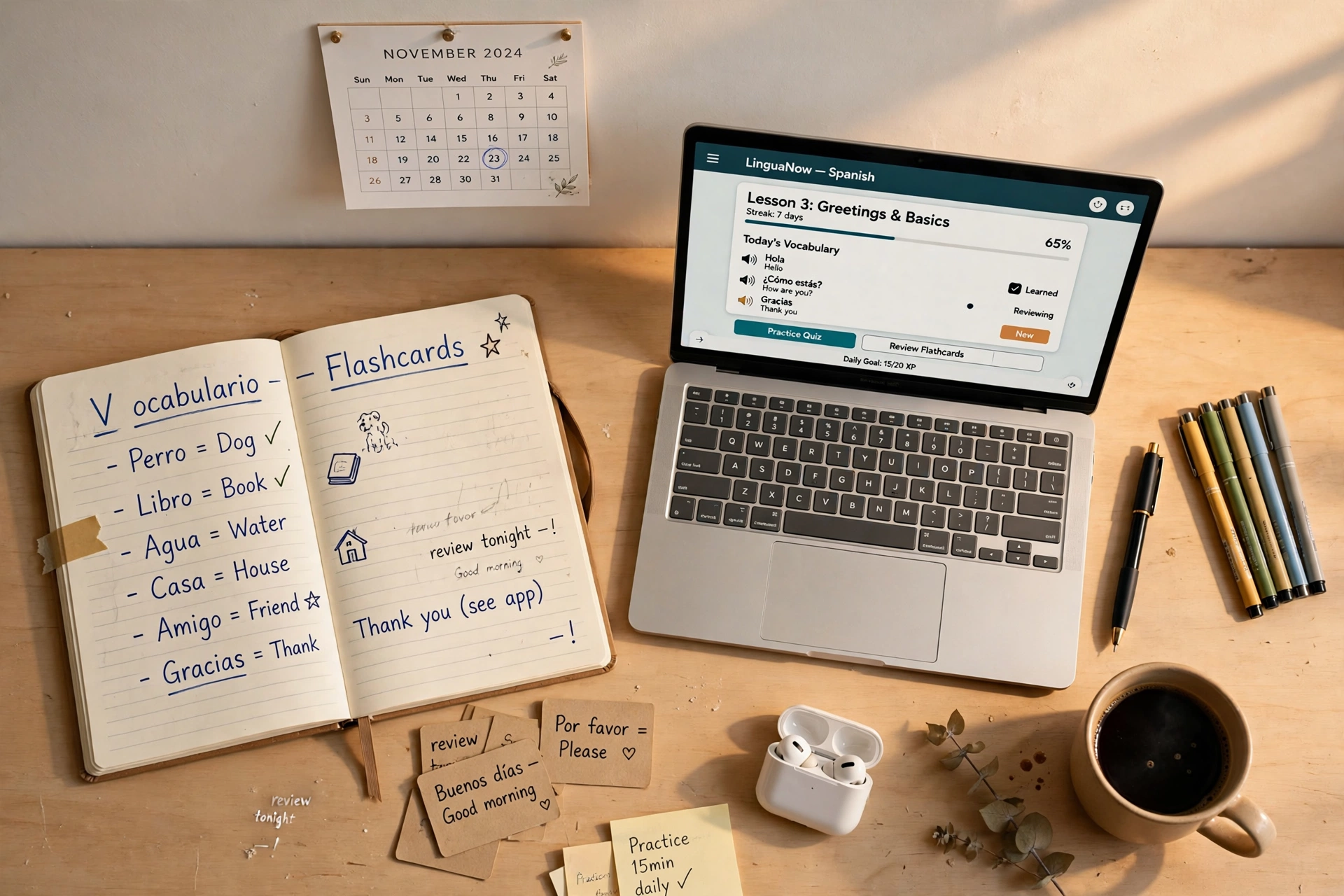
Text chat cannot hear you, but AI can still help your pronunciation. Two methods work well:
Shadowing. Ask the AI for a short dialogue, then listen to it read aloud in voice mode and repeat each line right after it, matching the rhythm and stress. Do the same dialogue three days in a row. Your mouth learns the sounds by copying them.
Minimal pairs. These are pairs of words that differ by one sound, such as “ship” and “sheep” in English. Ask the AI for ten minimal pairs that are hard for speakers of your language, with a short sentence for each. Practicing the difference trains your ear as well as your mouth.
Also ask the AI to explain sounds in plain words: which syllable is stressed, where your tongue goes, and which letters are silent. For real feedback on how you sound, though, you still need a human ear or a dedicated pronunciation app. AI text chat can describe a sound, but it cannot hear yours.
You do not need hours a day. Twenty focused minutes, done daily, beats a long session once a week. Here is a routine that covers speaking, writing, and words:
On days when you have more time, add ten minutes of reading at your level. On busy days, do just the five-minute review. Keeping the streak matters more than the length of any single session.
A routine is good, but a plan with a clear order is better. Here is a plain 30-day plan for a beginner:
Week 1: Get started. Set your level and goal. Learn greetings, numbers, and 50 common words. Do one short role-play a day: introducing yourself, ordering food, asking for directions.
Week 2: Start speaking in sentences. Practice the present tense and five everyday verbs. Write three sentences a day and get them corrected. Learn the words for your daily routine: morning, work, food, home.
Week 3: Add listening and reading. Read one short graded text a day. Listen to a slow dialogue and shadow it. Learn question words: who, what, where, when, why, and how.
Week 4: Put it together. Hold a five-minute conversation on one topic without switching to English. Write a short paragraph about your week. Review your mistake log and redo the grammar points that kept coming up.
After 30 days you will not be fluent, and no honest guide should promise that. But you will be able to introduce yourself, handle simple situations, and read easy texts. That is a real result, and it is the base the next 30 days build on.
Most of what this guide describes works on free plans. Here is the honest picture as of late 2026:
| Tool | What is free | What paid adds |
|---|---|---|
| ChatGPT | Text chat, voice mode with daily limits, and basic corrections | Plus (about $20 a month) gives longer voice sessions and faster replies |
| Google Gemini | Text chat and practice ideas with limits | Google AI plans add higher limits and more features |
| Duolingo | Short daily lessons with ads and limits | Super removes ads and limits mistakes |
| DeepL | Translation with usage limits | Pro raises the limits |
| Anki | Free on desktop and the web | Mobile app costs a one-time fee on iPhone |
Start free. Pay only when you hit a limit that actually bothers you, such as voice mode cutting off mid-session. Prices and limits change often, so check each provider’s official site before you pay. You can learn a lot with ChatGPT on its free plan and Duolingo for daily habit building, and that combination costs nothing.
Using AI as a translator. If you paste English and copy the translation, you are not learning. Write in your language first, even badly, then ask for corrections.
Only chatting, never speaking to real people. AI is patient and predictable. Real people mumble, interrupt, and use slang. Use AI to build confidence, then use that confidence with real speakers, a tutor, or a language exchange partner.
Trusting every correction. AI can be wrong, especially on grammar in less common languages and on regional expressions. If a rule surprises you, check it in a dictionary or ask a teacher.
Learning words without using them. A list of 500 words you never spoke is worth less than 50 words you use every week. New words need sentences, role-plays, and review.
No plan, only random chats. Chatting about a different topic every day feels like progress but teaches little. A short daily routine and a weekly goal keep you moving in one direction.
Skipping listening. Reading and writing alone will not teach you to understand fast speech. Listen every day, even for ten minutes, and shadow what you hear.
Not on its own. AI is a strong practice partner for conversation, corrections, vocabulary, and graded reading. But it cannot give you a structured course, real listening to native speakers, or feedback on your pronunciation. Pair AI practice with a course, a textbook, or a tutor for the best results.
For most learners, a general chatbot such as ChatGPT or Gemini is the best starting point, because it can chat, correct writing, explain grammar, and role-play. Add a dedicated app for the gaps: Duolingo for daily habits, Anki for vocabulary review, and a pronunciation app or tutor for speaking feedback.
Not directly in text chat, because it cannot hear you. In voice mode it can hear your speech and comment on it, but the feedback is rough. For serious pronunciation work, use shadowing, minimal pairs, and a tutor or a dedicated pronunciation app that listens to you.
No, on its own it is not enough. Duolingo is good for building a daily habit and learning basic words, but it gives you very little real speaking practice. Use it as one part of your routine, with AI conversation practice and real reading and listening beside it.
It depends on the language, your level, and how much time you give it. With 20 focused minutes a day, most learners can hold simple conversations in a language close to their own within three to six months. Languages very different from your own take longer. Daily practice matters far more than the tool you choose.
You can, but be careful. AI is trained on far more text in Spanish, French, German, and other widely spoken languages than in less common ones. Its corrections and explanations are less reliable there. Check anything important with a dictionary, a native speaker, or a teacher.
AI makes one part of language learning much easier: getting lots of practice. You can speak every day, get your writing corrected in seconds, and read texts written exactly at your level. The method is simple: set your level and goal, practice speaking with voice mode, role-play real situations, write a little every day and learn from the corrections, build vocabulary in sentences, and read and listen a little daily.
Start tonight with twenty minutes: five on review, ten on one conversation, five on writing. Do the same tomorrow. A language is learned in small daily steps, and AI just made those steps easier to take.

Taylor Orlando is a content writer at Meregate covering websites, SEO, and AI. Taylor breaks down complex topics into simple, practical guides that help small businesses build better websites, rank higher on Google, and get real value from AI tools — no jargon, no fluff.
Twelve AI tools that help small businesses find leads, check contact details, and send outreach — with honest free-plan limits and prices.

Learn how to use AI to write a book step by step — from idea to outline, draft, edit, and publish on Amazon KDP.

AI tools now help doctors write notes, read scans, answer clinical questions, and talk with patients. Here are 12 of the best for 2026, with honest prices and free options for small clinics.