
Artificial Intelligence
Are AI Chatbots Worth It for a Small Business? (2026)
A chatbot pays off when repeat questions pile up and customers message after hours. This guide weighs the real costs against the returns, and shows when the answer is no.

 By Taylor Orlando
·November 20, 2026
Machine learning is a way for computers to learn from examples instead of following rules that a person wrote for them. You show a computer lots of examples, it finds the pattern in them, and then it uses that pattern to make a guess about something new. That is the whole idea, and almost everything else about machine learning builds on it.
You already use machine learning every day, even if you never think about it. Your email app moves junk mail to the spam folder. Your phone unlocks when it sees your face. Netflix suggests a show you might like. Your keyboard guesses the next word as you type. None of these apps were given a fixed list of rules for every case. They learned from examples, and they keep getting better as they see more of them.
This guide explains machine learning in plain words: what it is, how it differs from artificial intelligence and deep learning, how a machine actually learns step by step, the main types, where it is used, and what it cannot do.
Machine learning is a part of artificial intelligence in which a computer learns from data. The word “data” just means examples: emails marked as spam or not spam, photos of cats and dogs, past house prices, or songs you skipped and songs you played all the way through.
Think of it like teaching a child. You do not hand a child a rulebook that says “a cat has pointy ears, a short nose, and whiskers.” You show the child many photos of cats and many photos of dogs. After enough examples, the child can look at a new photo and say “that is a cat.” Machine learning works the same way. The computer studies many labeled examples, finds what the examples in each group have in common, and then makes a call on new examples it has never seen before.
The finished product of this learning is called a model. A model is just the set of patterns the computer worked out from the examples. Once the model is built, you can feed it new data and it gives you a prediction: “this email is probably spam,” “this photo probably shows a dog,” or “this house will probably sell for about this much.”
A few words you will see again and again:
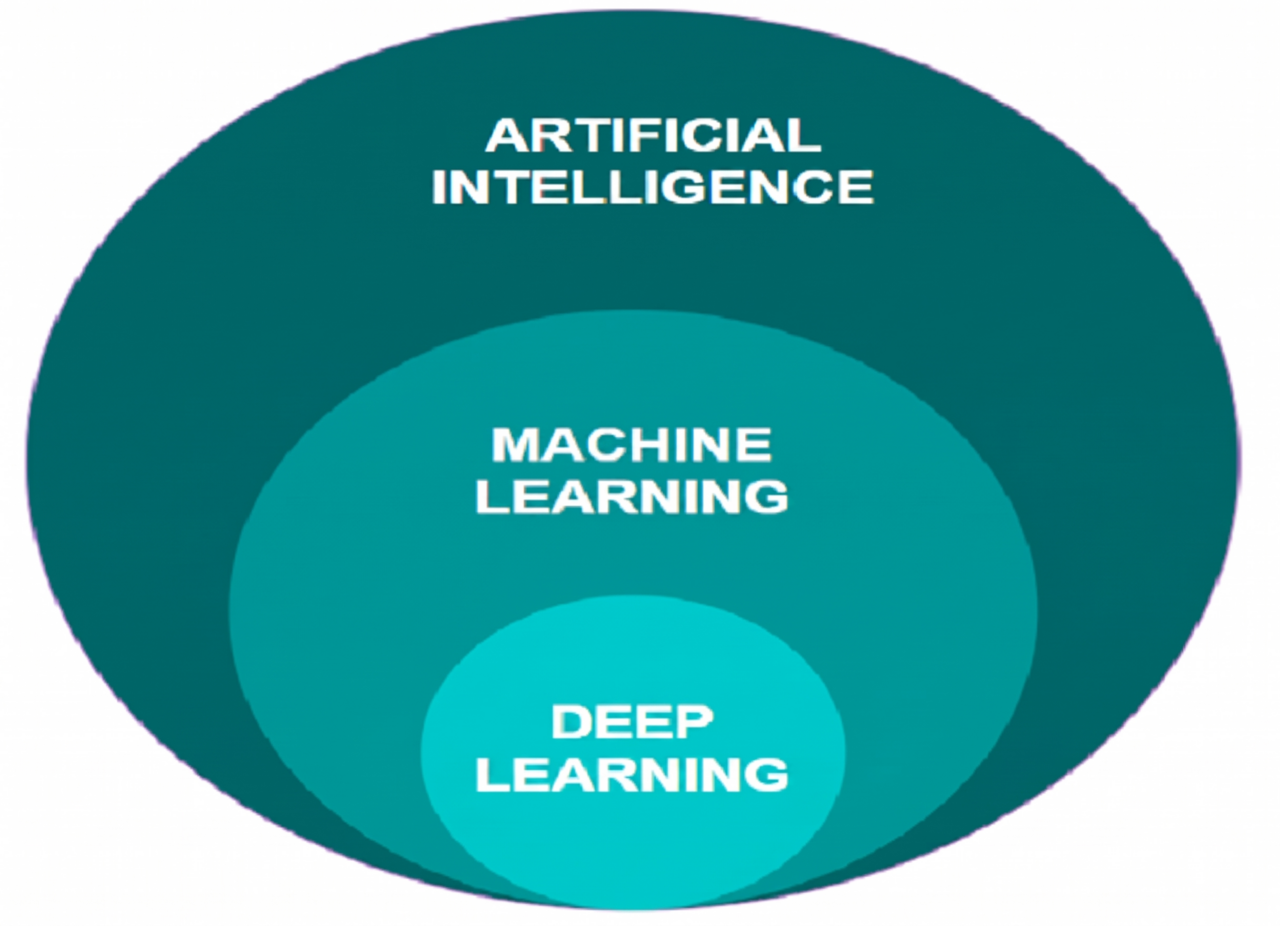
These four terms get mixed up a lot, so here is the simple way to keep them straight. They sit inside each other, like boxes within boxes.
Artificial intelligence (AI) is the biggest box. It covers anything that makes a computer act smart, including old-fashioned systems that just follow rules a person wrote. A thermostat that turns the heat on when the room drops below a set temperature is a tiny piece of AI, but it learns nothing.
Machine learning (ML) sits inside AI. It is the part of AI where the computer learns the rules from examples instead of having them written out by a person. All machine learning is AI, but not all AI is machine learning.
Deep learning sits inside machine learning. It uses a type of model called a neural network, built in many layers, which is very good at working with photos, sound, and text. ChatGPT and image generators are built on deep learning.
Generative AI sits inside deep learning. It is the kind of AI that creates new things: text, images, music, or code. ChatGPT is generative AI, and generative AI is powered by machine learning.
Here is a quick test you can use any time you are unsure which term fits:
| Term | What it means | Example |
|---|---|---|
| Artificial intelligence | The big idea: computers doing smart tasks | A chess program, a thermostat, a chatbot |
| Machine learning | AI that learns patterns from examples | A spam filter, a movie recommender |
| Deep learning | Machine learning with many-layer neural networks | Face unlock, voice assistants |
| Generative AI | Deep learning that creates new content | ChatGPT, image generators |
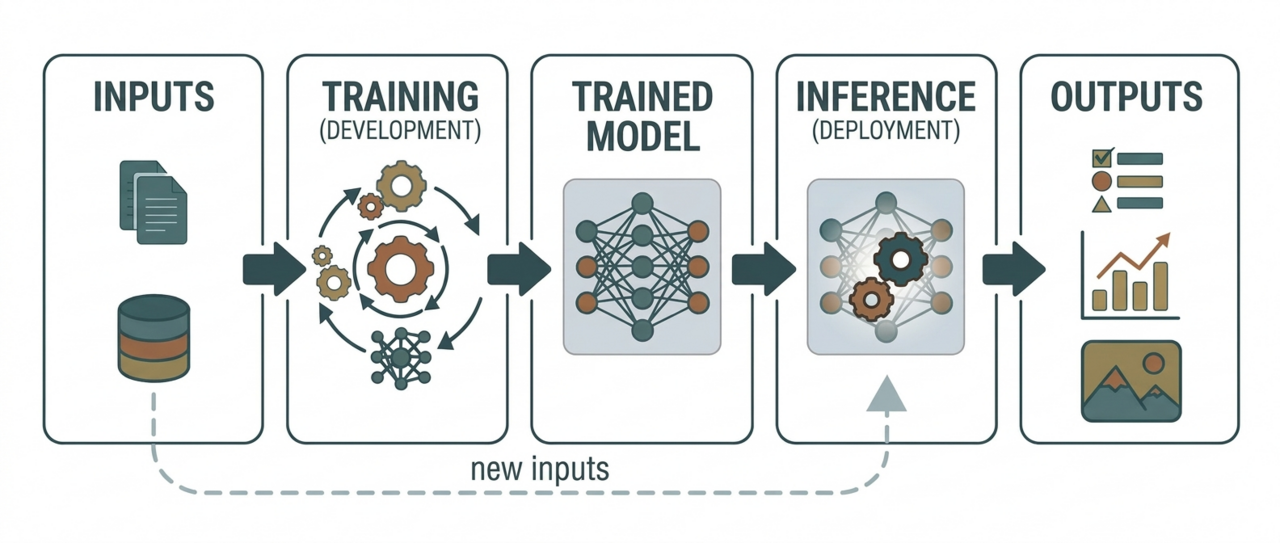
The best way to understand how machine learning works is to follow one example all the way through. Take a spam filter, the tool that keeps junk out of your inbox. Here is what happens, in five steps.
Step 1: Collect examples. The email service gathers thousands of emails. People have already marked some as spam and some as not spam. These marked emails are the training data. Each email is an example with an answer attached.
Step 2: Show the examples to the model. The computer looks at the spam emails and the normal emails and starts to notice what is different. Spam emails often have words like “free prize” or “act now,” lots of exclamation marks, and strange links. Normal emails look different. The computer turns these clues into patterns.
Step 3: The model guesses. Now the computer tries its hand at new emails. For each one, it guesses “spam” or “not spam” based on the patterns it found.
Step 4: Check how wrong it was. Each guess is checked against the real answer. Every time the model is wrong, it notes how far off it was. A spam email it called normal is a mistake, and so is a normal email it sent to the spam folder.
Step 5: Adjust and repeat. The model tweaks itself a little to do better next time, then goes through the examples again. It repeats this loop, guess, check, adjust, thousands of times. With each round, its mistakes shrink.
That loop, guess, check, adjust, repeat, is the heart of machine learning. It is not magic. It is a lot of small corrections, done very fast.
Two more ideas matter here:
Training data and test data are kept apart. Some emails are held back and never shown during training. After training, the model is tested on these fresh emails. If it does well on emails it has never seen, it has really learned the pattern. If it only does well on the emails it trained on, it just memorized the answers. That problem is called overfitting, and it is one of the most common ways a model fails in real life.
Good data matters more than a clever model. If the training emails are old, one-sided, or full of mistakes, the model will learn the wrong patterns. Bad examples in, bad guesses out. People in the field sum this up as “garbage in, garbage out.”
The difference between machine learning and the old way of writing software is simple. In traditional programming, a person writes the rules, and the computer follows them. In machine learning, a person supplies the examples, and the computer works out the rules itself.
Say you want to spot spam email the old way. You would write rules by hand: “If the email has the word ‘lottery’ and comes from an unknown sender, mark it as spam.” That works until spammers change their words. Then you have to write new rules, and the list never ends.
With machine learning, you skip the hand-written rules. You feed the computer thousands of emails marked spam or not spam, and it finds the patterns on its own. When spammers change their tricks, you feed it fresh examples and it updates its patterns. That is why machine learning is the right tool for problems where the rules are hard to write down but easy to show with examples: recognizing faces, understanding speech, or guessing what a person might want to watch next.
On the other hand, when the rules are clear and never change, plain programming is still better. A calculator does not need machine learning. A program that adds up a bill does not need to learn from examples. Machine learning is a tool for fuzzy problems, not for every problem.
There are three main ways a machine can learn from data. Think of them as three kinds of teaching.
In supervised learning, every example comes with the right answer. The computer studies examples with answers and learns to predict the answer for new examples. This is the most common type of machine learning.
Examples: a spam filter trained on emails labeled spam or not spam, a bank model trained on past loans labeled “paid back” or “defaulted,” or a house-price model trained on past sales with their prices. Supervised learning splits into two jobs: classification (picking a label, like spam or not spam) and regression (guessing a number, like a house price).
In unsupervised learning, the examples come with no answers at all. The computer looks for groups and patterns on its own. It is like handing someone a pile of mixed photos and asking them to sort the pile into groups that look alike, without telling them what the groups are.
Examples: a store grouping customers by shopping habits, a music app finding clusters of listeners who like the same kind of songs, or a news site grouping similar stories together. The main job here is called clustering.
In reinforcement learning, the computer learns by trying things and getting a score. A good move earns a reward, a bad move earns a penalty, and over many rounds the computer learns which moves pay off. It is like learning a video game by playing it over and over.
Examples: a program that learned to play chess or Go by playing millions of games against itself, a robot learning to walk by trial and error, or a system that picks the best ad to show you based on what you clicked before.
There is also a mix called semi-supervised learning, which uses a small set of labeled examples plus a large set of unlabeled ones. It is handy when labeling examples by hand would take too long, like labeling thousands of medical images. In practice, real systems often mix these types. A large language model like ChatGPT, for example, is first trained on huge amounts of text, then fine-tuned with human feedback, which is a form of reinforcement learning.
| Type | Plain meaning | Everyday example |
|---|---|---|
| Supervised learning | Learning with an answer key | Spam filter trained on labeled emails |
| Unsupervised learning | Sorting without labels | Grouping shoppers by buying habits |
| Reinforcement learning | Learning by trying and getting a score | A game-playing program that improves by playing |
Machine learning is already part of an ordinary day. Here is what a normal day looks like through its lens.
Morning: your phone unlocks by recognizing your face. Your email app has already filtered the spam. Your maps app predicts how long the drive to work will take based on current traffic.
Afternoon: you search for a product and the store shows you items people like you also bought. Your music app builds a playlist from songs you played before. Your keyboard suggests the next word before you type it.
Evening: a streaming service lines up shows it thinks you will like. Your voice assistant understands what you said and answers. Your photo app finds every picture of your dog when you search for it.
Each of these is the same idea at work: a model that learned patterns from past examples and now makes a guess about something new. Behind the scenes, businesses use the same idea on a bigger scale: banks spot fraud by noticing spending that breaks a person’s usual pattern, hospitals help doctors read scans, stores forecast what will sell next week, and factories predict when a machine is about to break down so it can be fixed in time.
Machine learning is not as new as it feels. A few dates tell the story:
Machine learning is powerful, but it is easy to expect too much from it. Here is what it cannot do, in plain words.
It does not understand. A model that writes a good essay does not know what the essay means. It found patterns in text. It has no real understanding, no common sense, and no awareness of being right or wrong.
It is only as good as its data. If the examples are old, one-sided, or full of errors, the model will repeat those flaws. A hiring model trained on past hiring choices can pick up old biases and repeat them. A medical model trained mostly on one group of patients may work poorly for others.
It can be wrong with confidence. A model can give a wrong answer and look sure about it. It has no way to say “I am not sure” unless someone builds that in. That is why a human still needs to check important decisions, like a medical scan or a loan approval.
It cannot explain itself well. Many models, especially deep learning ones, are hard to open up and inspect. You can see the answer, but not always the reason. This “black box” problem matters in areas like health care and law, where the reason behind a decision counts.
It needs a lot of data and computing power. Training a big model takes huge amounts of data, powerful computers, and energy. That is why the biggest models are built by large companies, not by one person on a laptop.
It cannot learn from nothing. A model cannot invent knowledge it has never seen in any form. If a problem has no examples to learn from, machine learning is the wrong tool, and simple rules or human judgment will do better.
Yes, and you do not need to be a math expert to start. To understand machine learning, you only need curiosity and a bit of time. If you want to build models yourself, the usual path is: basic Python programming first, then simple statistics, then a beginner course on supervised learning. Free courses from Google and Stanford are good starting points, and you can run your first small model in an afternoon with tools like scikit-learn.
Be realistic about speed, though. You cannot learn machine learning in one month. In a month of steady study, you can understand the ideas in this guide, run a few simple models, and know what the terms mean. Real skill takes several months of practice with real data. That is normal, and it is true for almost any useful skill.
Machine learning is a way for computers to learn from examples instead of following fixed rules. You show a computer many examples, it finds the pattern in them, and then it uses that pattern to guess the answer for new examples.
Artificial intelligence is the big idea: computers doing smart tasks. Machine learning is one part of AI, the part where the computer learns from examples instead of having rules written out for it. All machine learning is AI, but not all AI is machine learning.
Both. ChatGPT is an AI product, and it is built on machine learning. Under the hood, it is a large language model, a kind of deep learning model trained on huge amounts of text. So ChatGPT is AI that works because of machine learning.
You can learn the basics in a month: what it is, how it works, and the main types. You can also run a simple model or two. But real skill takes longer, usually several months of practice with real data. Start with Python and a beginner course, and build from there.
It is used to spot spam, recommend movies and songs, unlock phones with face recognition, predict traffic, detect bank fraud, help doctors read scans, forecast sales, and power chatbots and voice assistants. Any job where a computer can learn a pattern from past examples is a candidate.
No. You can understand what machine learning is and how it works without writing a line of code. Coding is only needed if you want to build models yourself, and even then, free tools and courses make the first steps easy.
Machine learning sounds complex, but the core idea is simple: learn from examples, find the pattern, and make a guess about what comes next. The next time your phone unlocks with your face or your inbox hides a spam email, you will know what happened behind the screen. If you want to go deeper, IBM’s guide to machine learning covers the technical side in detail, and Google’s intro course walks through the basics with short lessons. For the business view, MIT Sloan’s explainer shows how companies put it to work.

Taylor Orlando is a content writer at Meregate covering websites, SEO, and AI. Taylor breaks down complex topics into simple, practical guides that help small businesses build better websites, rank higher on Google, and get real value from AI tools — no jargon, no fluff.
A chatbot pays off when repeat questions pile up and customers message after hours. This guide weighs the real costs against the returns, and shows when the answer is no.

Synthesia leads for training, HeyGen for marketing and translation, Pictory for blog posts to video. This guide compares 7 tools on price, brand kits, commercial use and team seats.

AI learns from examples: it finds patterns in huge amounts of data and uses them to predict what comes next. This simple guide walks through the whole process step by step.