SEO Best Practices 2026: 13 Ways to Rank Higher

If you’re looking for SEO best practices that actually work in 2026, you’re in the right place. Search has changed a lot lately. AI Overviews now answer many questions right on the results page, and Google keeps rolling out updates that reward real, helpful content.
But here’s the good news: the fundamentals of SEO still matter, and most websites fail at the basics. This guide walks you through 13 SEO best practices that work right now — written in plain English for beginners and small business owners. You’ll learn what changed in 2026, what stayed the same, and the exact steps that bring more traffic from Google.
Is SEO Dead in 2026?
Short answer: no. People still run billions of searches every day, and Google is still the main way most websites get found.
What actually died is the old playbook. Stuffing keywords into every sentence, publishing thin 300-word blog posts, and buying cheap links stopped working years ago — and in 2026 they can actively hurt you. What works now is simpler to describe but harder to fake: genuinely helpful content, a fast and trustworthy website, and a good reputation online.
One more honest note: you’ll see new acronyms everywhere — AEO, GEO, “search everywhere optimization.” Some experts treat these as brand-new disciplines. Others, including several quoted in a 2026 expert roundup, say it’s still just SEO with new names: “nothing you should be doing differently today for AI search than for regular search.” The truth is in the middle. The tactics below help you rank on Google and get cited in AI answers, because both reward the same things: clear answers, trustworthy sources, and clean technical setup.
What Changed in SEO (and What Didn’t)
What changed:
- AI Overviews answer simple questions directly. For many basic queries, users now get an AI-written answer at the top of Google and never click anything. That means clicks are harder to earn — but being cited in those answers is a new way to get seen.
- Google’s AI Mode offers a fully conversational search experience, pulling from the same web content as regular search.
- Core Web Vitals use INP now. Google replaced First Input Delay (FID) with Interaction to Next Paint (INP) as its responsiveness metric back in March 2024. If a guide still tells you to optimize FID, it’s outdated.
- Experience matters more. Google’s E-E-A-T guidelines (Experience, Expertise, Authoritativeness, Trustworthiness) keep gaining weight. Content with real proof — original data, photos, case studies — beats generic rewrites.
What didn’t change:
- Helpful, original content still wins. Google’s own SEO starter guide says it plainly: there are no secrets that automatically rank a site first — just best practices that make your content easier to find and understand.
- Links from other sites still count as votes of confidence.
- Fast, mobile-friendly pages still rank better than slow ones.
- Matching what the searcher actually wants is still the single most important ranking factor.
The 5 Building Blocks of SEO
Every SEO task fits into one of five buckets. Understand these and the rest of this guide will make sense:
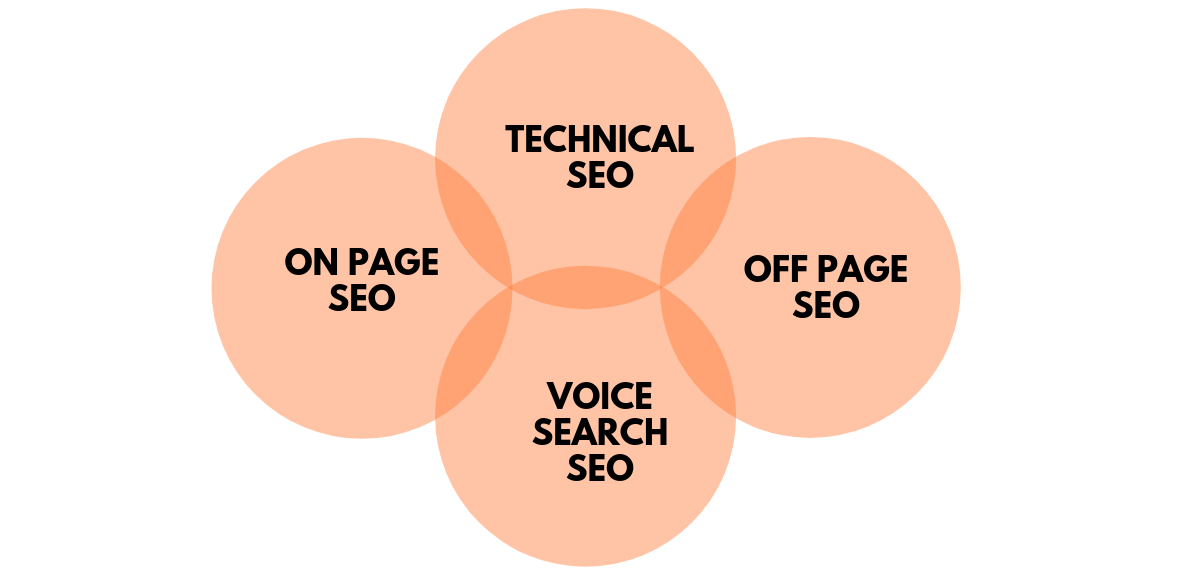
- Keyword research — finding the words your customers actually type into Google.
- On-page SEO — optimizing the content on your pages: titles, headings, text, and images.
- Technical SEO — making sure Google can find, crawl, and understand your site (speed, mobile-friendliness, sitemaps).
- Content — publishing pages that genuinely answer questions better than what’s already ranking.
- Off-page SEO — earning links and mentions from other reputable sites.
13 SEO Best Practices That Work in 2026
1. Match Search Intent First
Before you write a single word, Google your target keyword and look at what’s already ranking. If the top results are step-by-step guides, searchers want a guide — not a product page. If they’re product pages, they want to buy — not read 2,000 words.
This is called search intent, and matching it is the most-skipped step in SEO. A perfect article that answers the wrong question will never rank.
2. Do Keyword Research (Start Free)
You don’t need expensive tools to start. Type your topic into Google and note the autocomplete suggestions — those are real searches from real people. Scroll to “People also ask” and the related searches at the bottom of the page. Once your site gets traffic, Google Search Console (free) shows you the exact queries bringing people in.
Rule of thumb: target one main keyword per page, plus a few closely related phrases. Don’t create five pages competing for the same keyword — Google won’t know which one to rank.
3. Put Your Keyword Near the Front of Your Title
Your title tag is the blue headline people see in search results. Keep it under 60 characters, put your main keyword near the beginning, and make it sound like something a human would click. Compare:
- Weak: “Welcome to Our Blog — Thoughts and Updates”
- Strong: “SEO Best Practices 2026: 13 Ways to Rank Higher”
The strong version tells both Google and the reader exactly what the page is about.
4. Answer the Question in the First 100 Words
Don’t bury the answer under three paragraphs of introduction. State the key point early, then expand. This helps impatient readers — and it helps AI systems too, which prefer pages that give clear, direct answers they can quote.
5. Write for People, Format for Machines
Great content still needs great formatting. Use short paragraphs, descriptive subheadings, bullet lists, and tables where they help. Aim to include a concise 40-to-60-word answer to the page’s main question somewhere near the top — that’s roughly the length AI Overviews like to cite.
Also add schema markup (structured data) where it fits. FAQ, Article, and Product schema help Google understand your page and can earn you rich results. Most SEO plugins, including Rank Math, can add basic schema with a few clicks — see schema.org for the full vocabulary.
6. Speed Up Your Site
Google measures real-world page experience with three Core Web Vitals. Here are the “good” thresholds for 2026, measured from real visitor data:
- LCP (Largest Contentful Paint): under 2.5 seconds — how fast the main content loads
- INP (Interaction to Next Paint): under 200 milliseconds — how quickly the page responds when someone clicks or taps
- CLS (Cumulative Layout Shift): under 0.1 — how much the layout jumps around while loading
Fewer than half of all websites pass all three, so this is a real competitive edge. The biggest wins usually come from compressing images, removing unused plugins and scripts, and using caching. Check your scores in PageSpeed Insights or Search Console’s Core Web Vitals report — and remember these act as a tiebreaker: great content on a slightly slow page still beats thin content on a fast one.
7. Make Mobile Your Priority
Google now indexes just about every site using its mobile crawler, and most of your visitors are on phones. If your site is hard to use on a small screen — tiny text, buttons too close together, pop-ups covering the content — your rankings will suffer no matter how good your content is. Test your key pages on an actual phone, not just by shrinking your desktop browser.
8. Use One H1 and Clean Headings
Every page should have exactly one H1 (usually your page title), followed by a logical H2/H3 structure. Think of headings as an outline: a reader should be able to scan them and understand the whole page. Sprinkle related keywords into headings naturally — never force them.
9. Optimize Your Images
Images are the most common reason pages load slowly. Compress every image before uploading (tools like TinyPNG are free), use modern formats like WebP when you can, and give files descriptive names like seo-best-practices-checklist.png instead of IMG_0042.png. Always write alt text that describes what’s in the image — it helps visually impaired visitors and gives Google more context.
10. Earn Links With Original Work
Backlinks — links from other websites — are still one of Google’s strongest trust signals. But the days of link schemes are over. The safe way to earn links in 2026:
- Publish something original: a small survey, a case study, useful data, or a free tool.
- Write the best resource on a narrow topic, then let relevant sites know it exists.
- Get listed in legitimate directories and industry roundups.
- Create content people naturally reference: definitions, statistics, templates.
Never buy links, and avoid anyone promising “1,000 backlinks for $50.” Those links come from spammy sites and can trigger a penalty that’s painful to recover from.
11. Keep Your Site Technically Healthy
A few technical basics prevent most indexing problems:
- Submit an XML sitemap in Search Console and keep it updated.
- Make sure your robots.txt isn’t accidentally blocking important pages.
- Use HTTPS everywhere — Google has treated it as a ranking signal for years, and browsers warn visitors away from non-secure sites.
- Fix broken links and redirect deleted pages instead of leaving them as 404s.
- Use canonical tags if the same content is reachable at multiple URLs.
12. Track Results in Search Console
You can’t improve what you don’t measure. Google Search Console is free and shows which queries bring you traffic, your average position, and which pages need work. Watch impressions and average position — not just clicks. With AI Overviews answering more queries on the results page itself, a page can be gaining visibility even when clicks stay flat. That’s the new reality of measuring SEO.
13. Update Your Old Content
SEO isn’t “publish and forget.” Once or twice a year, revisit your most important pages: refresh outdated statistics, fix broken links, add new sections competitors now cover, and update the date. Google favors fresh, accurate content — and updating a page that already ranks is often faster than ranking a new one from scratch.
Common SEO Mistakes to Avoid
- Keyword stuffing. Repeating your keyword unnaturally doesn’t help — Google understands synonyms and context now.
- Buying links or joining link schemes. Short-term gains, long-term penalties.
- Publishing thin content at scale. Fifty AI-generated 400-word posts will lose to one genuinely useful guide. (Publishing twice a week means nothing if the content is shallow.)
- Ignoring search intent. Writing a sales page when searchers want a tutorial.
- Forgetting technical basics. A noindexed page or a blocked robots.txt can silently kill all your content work.
- Chasing every new acronym. Whether you call it SEO, AEO, or GEO, the work is the same: be the clearest, most trustworthy answer.
- Never measuring anything. If you don’t check Search Console, you’re flying blind.
Can You Do SEO Yourself?
Yes — especially when you’re starting out. Most of the practices above cost nothing but time. Here’s a realistic first-30-days plan:
- Days 1–7: Set up Google Search Console, check that your pages are indexed, and rewrite your five most important title tags.
- Days 8–14: Run PageSpeed Insights on your homepage and fix the biggest issues (usually images).
- Days 15–21: Pick one keyword your customers search for and publish the best, most complete answer you can.
- Days 22–30: Add schema markup with your SEO plugin, fix any broken links, and share your new page where your audience hangs out.
Consider hiring help only when the technical work exceeds your comfort zone or when you’re competing in a tough market — and even then, the basics above still apply.
Quick SEO Checklist for 2026
- One main keyword per page, matched to search intent
- Keyword near the front of a sub-60-character title
- Direct answer in the first 100 words
- One H1, logical H2/H3 structure
- Compressed images with descriptive filenames and alt text
- LCP under 2.5s, INP under 200ms, CLS under 0.1
- Mobile-friendly layout, HTTPS everywhere
- Schema markup (Article, FAQ, or Product)
- Original content worth linking to — never bought links
- XML sitemap submitted, no accidental blocks in robots.txt
- Search Console tracking impressions, position, and clicks
- Old content refreshed at least once a year
SEO Best Practices: FAQs
Is SEO still relevant in 2026?
Yes. Search is shifting from pure keyword rankings to visibility across Google, AI Overviews, and other platforms — but the underlying work (helpful content, technical health, trust) matters more than ever.
What are the 5 components of SEO?
Keyword research, on-page SEO, technical SEO, content, and off-page SEO (links and mentions). Master these five and you cover roughly 90% of what matters.
Can I do SEO on my own?
Absolutely, especially at the start. The free tools — Google Search Console, PageSpeed Insights, and Google’s own documentation — cover most beginner needs. Hire an expert later for technical audits or highly competitive niches.
Is SEO difficult to learn?
The basics aren’t. If you can write clearly, follow a checklist, and check your results monthly, you can handle SEO for a small site. The difficulty scales with competition, not with the concepts.
What is the 80/20 rule in SEO?
Roughly 80% of your results come from 20% of your efforts: a handful of pages bring most of the traffic. Identify your winners in Search Console and invest in improving them first.
What are common SEO mistakes?
Keyword stuffing, buying links, ignoring mobile users, publishing thin content, never updating old pages, and failing to measure results in Search Console.
Will SEO exist in 5 years?
The name might evolve, but the job won’t disappear. As long as people search for answers — on Google, in AI chatbots, or wherever comes next — someone will need to make content findable. The tactics in this guide transfer to all of them.
The Bottom Line
SEO in 2026 isn’t about tricks or secret tactics. It’s about doing the fundamentals well: understand what searchers want, answer clearly, keep your site fast and trustworthy, and earn your reputation one good page at a time. Start with the checklist above, measure in Search Console, and improve a little every month. That’s the whole game.
Last updated: October 2026.